 RadixPro
RadixPro
RadixPro
Industrial machinery rarely fails because of one dramatic mistake. More often, a reducer runs hot, vibrates, or loses precision after months of demanding service. The correct Gear Reduction Systems can prevent these problems, but selection requires more than comparing catalog ratios. Engineers must examine torque, speed, duty cycle, backlash, lubrication, mounting space, noise, and maintenance access. A conveyor gearbox may tolerate shock loads, while a robotic joint needs compact precision. The difference matters.
C. Walton Musser, the inventor associated with strain wave gearing, described the core purpose simply as “a mechanical speed reducer.” That modest phrase hides serious engineering decisions. A planetary gearbox can deliver high torque in a compact housing. A worm reducer offers useful self-locking behavior, but often sacrifices efficiency. Helical and bevel-helical units may provide smoother, quieter operation in continuous production lines. Harmonic and cycloidal designs can support demanding positioning tasks, though their costs and maintenance needs deserve honest attention.
This guide compares seven leading systems for industrial use. Each option is assessed through practical operating conditions, not marketing language alone. Expect trade-offs. No reducer is perfect. Even a carefully sized unit may underperform when alignment, lubrication, or thermal limits are ignored. Field experience also shows an uncomfortable truth: buyers sometimes choose the cheapest gearbox and pay more later through downtime. The discussion ahead focuses on reliable choices, measurable performance, and details that engineers can verify before installation.
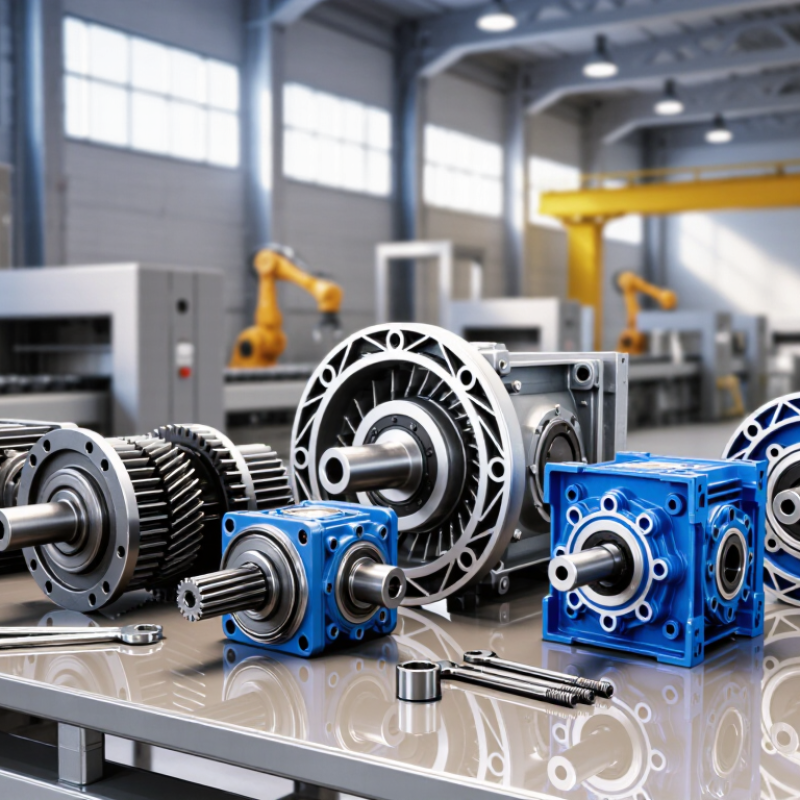
7 Best Gear Reduction Systems for Industrial Use
Gear ratios define speed, torque, and operating risk. A 10:1 reducer can lower output speed sharply, but torque does not rise freely. Efficiency, heat, backlash, and service factors consume part of the theoretical gain. The basic relationship is useful: torque equals 9,550 times power in kilowatts, divided by speed in rpm. Planetary systems usually offer high torque density. Helical and bevel-helical units suit continuous conveyor duty. Worm systems remain compact, but their efficiency can fall significantly at higher ratios.
Torque density matters when floor space is limited. It compares transmitted torque with gearbox mass or volume. A smaller housing is not automatically better. Bearing loads, lubrication, shock loading, and thermal capacity still control reliability. The U.S. Department of Energy reports that motor-driven systems use about 69% of electricity in U.S. manufacturing. Even a modest efficiency loss can therefore create measurable operating cost. Field audits often find oversized reducers running below their efficient load range. That is not always a design failure, but it deserves review.
ISO 6336 evaluates gear capacity through tooth-root bending and flank contact strength. Its calculations include load distribution, dynamic effects, and application factors. An ISO 6336 rating should be read as a design basis, not a guaranteed lifetime. Actual life changes with alignment, contamination, starts per hour, and temperature. Engineers should compare the rated torque with peak torque, not only nominal motor power. This detail is easy to miss.
| Gear reduction system | Typical overall ratio | Typical efficiency | Relative torque density | Load-rating standard relevance | Common industrial applications | Key selection consideration |
|---|---|---|---|---|---|---|
| Inline helical | About 3:1–100:1; higher ratios are commonly achieved with multiple stages. | Typically about 94–98% per stage, depending on design and operating conditions. | Medium to high | ISO 6336 is commonly used to assess cylindrical gear tooth bending strength and surface durability. | Conveyors, mixers, pumps, and general-purpose machinery. | Efficient and quiet; check the required output speed, service factor, and mounting arrangement. |
| Parallel-shaft helical | About 3:1–200:1 across one or more stages. | Typically about 94–98% per stage. | High | ISO 6336 applies to the cylindrical helical gear meshes; the rating requires actual geometry, materials, and duty-cycle data. | Heavy conveyors, hoists, crushers, and material-handling equipment. | Suited to substantial radial and torque loads; verify shaft and bearing capacity as well as gear ratings. |
| Helical-bevel | About 5:1–200:1 in common multi-stage arrangements. | Typically about 92–97% for the complete reducer, depending on the number and type of stages. | Medium to high | ISO 6336 may be used for cylindrical helical stages; bevel gear meshes are generally assessed using ISO 10300. | Packaging lines, mixers, conveyors, and drives requiring a change in shaft direction. | Provides a right-angle drive; confirm the applicable rating method for each gear stage. |
| Planetary | About 3:1–100:1 per compact unit; higher ratios can use multiple stages. | Typically about 95–98% per stage. | Very high | ISO 6336 methods can be relevant to cylindrical planetary gear meshes, but load sharing and planet distribution must also be evaluated. | Mobile machinery, robotics, wind-turbine pitch drives, and high-torque compact equipment. | High torque capacity in a compact package; assess planet load sharing, bearing loads, and torsional stiffness. |
| Worm | About 5:1–100:1 in a single stage; larger reductions are possible in combined arrangements. | Often about 50–90%, strongly dependent on ratio, lead angle, lubrication, and operating conditions. | Medium | ISO 6336 is not the primary rating method for worm gear meshes; ISO/TS 14521 addresses worm gear load capacity. | Compact right-angle drives, indexing equipment, and applications needing high reduction in a single stage. | Can generate substantial heat at lower efficiencies; do not assume self-locking without a specific engineering check. |
| Cycloidal | About 10:1–100:1 per stage; multi-stage units can provide higher reductions. | Commonly about 85–95%, depending on construction and operating conditions. | High | ISO 6336 does not directly rate the cycloidal disc and pin-contact geometry; use the applicable manufacturer or design-specific rating method. | Robotics, positioning systems, shock-loaded drives, and compact high-ratio applications. | Known for impact tolerance and low backlash options; check output-bearing loads and torsional rigidity. |
| Spur gear | About 2:1–10:1 per stage; multiple stages provide higher overall ratios. | Typically about 95–99% per stage. | Medium | ISO 6336 is commonly used for cylindrical spur gear tooth bending and surface durability calculations. | Simple industrial drives, gear trains, and machinery operating with parallel shafts. | Efficient and straightforward to manufacture; tooth engagement can be noisier than helical gearing. |
| Engineering note: Ratio and efficiency figures are indicative ranges, not guaranteed product specifications. Actual torque capacity and torque density depend on gear geometry, materials, heat treatment, lubrication, cooling, bearings, duty cycle, and mounting. ISO 6336 provides calculation methods for cylindrical gear load capacity; it does not assign a single universal load rating to a gear reducer. | ||||||
Match torque, speed, duty cycle, space, and acceptable backlash to the machine. Real workload matters more than rated power alone.
A worm reducer can fit compact layouts and operate quietly. Sliding contact may lower efficiency to roughly 30–75%. Heat needs attention.
Cycloidal reducers handle shock loads well and often provide low backlash. Their efficiency commonly reaches about 80–90% under suitable conditions.
Harmonic reducers offer very low backlash and high reduction in small housings. Their flexible element may suffer from overload or repeated peak torque.
Planetary systems combine high torque, compact size, and efficiency near 90% in suitable conditions. Actual results depend on load sharing and cooling.
Count starts, stops, reversals, operating hours, and shock loads. A loaded conveyor start needs more margin than a steady fan.
Confirm mounting position, temperature, oil type, fill level, and maintenance intervals. Incorrect oil, dust, or misalignment can cause early damage.
Record output speed, temperature, vibration, and sound after commissioning. A new whine or rising vibration deserves investigation, but not every noise means failure.
No. Measure output speed under real load. A small speed error may reflect a changed load, not a defective reducer.
No single design wins every application. Spur, helical, bevel, bevel-helical, planetary, worm, and cycloidal units have different trade-offs. The comparison stays imperfect.
This guide compares seven Gear Reduction Systems used in industrial applications, explaining how reduction ratios and torque density affect performance and how load ratings, including ISO 6336 and AGMA 2101 considerations, help assess capacity and reliability. It reviews planetary, helical, and bevel gearboxes, which can achieve roughly 95–98% efficiency under suitable operating conditions, alongside worm, cycloidal, and harmonic drives, whose efficiency, speed range, and backlash characteristics vary more widely.
The comparison also considers torque capacity and service factors, then outlines practical selection criteria: duty cycle, lubrication needs, noise limits, and compatibility with IEC motors. Matching these factors to the application helps balance efficiency, precision, durability, and maintenance requirements when choosing an industrial drive system.
